
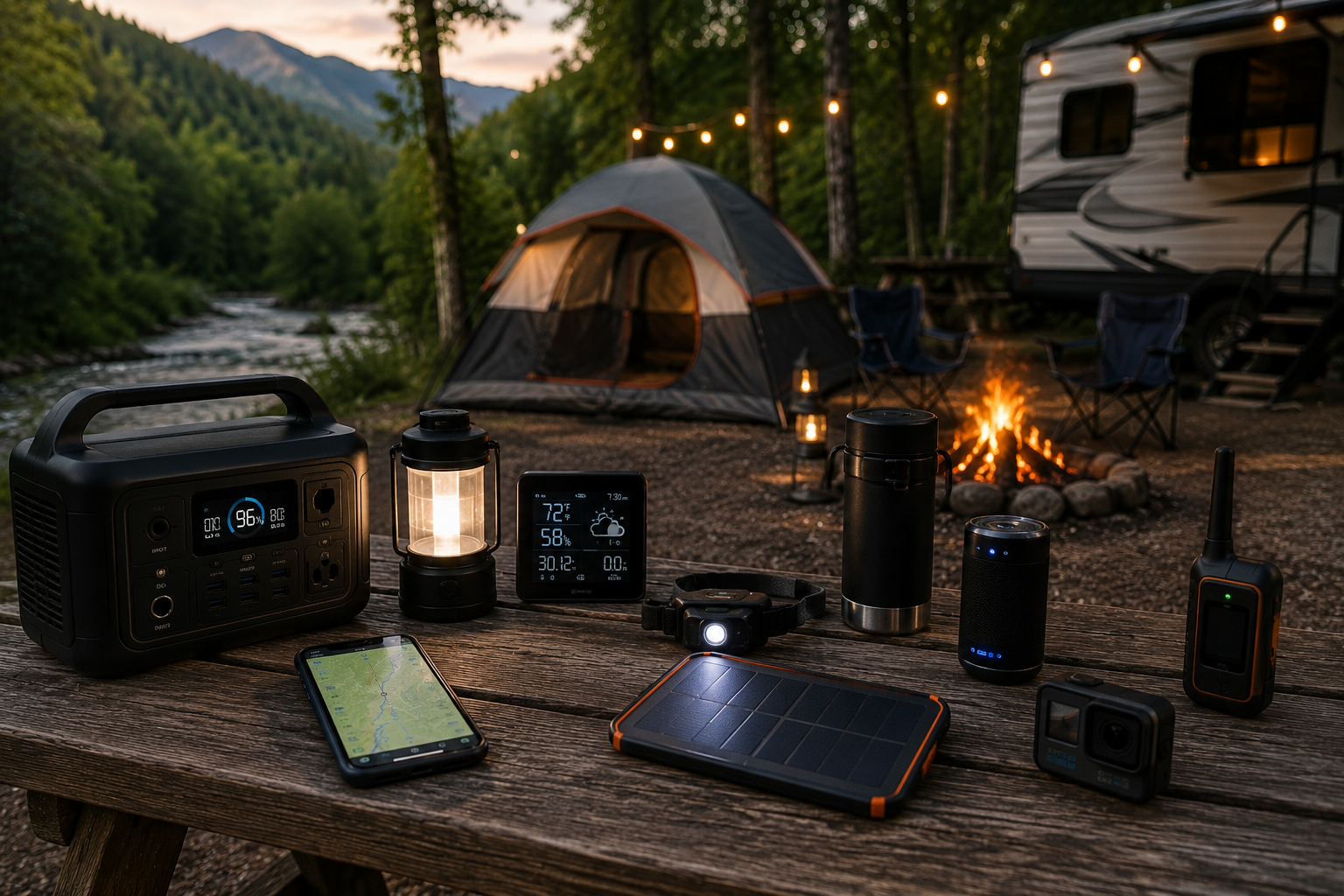
Camping technology used to mean carrying a flashlight instead of a lantern and maybe bringing a portable radio.
Things have changed.
Today’s smart camping gear can monitor your RV’s temperature, help manage battery usage, provide backup electricity, improve navigation, filter water, track weather, and keep travelers connected when they are far from home.
The goal isn’t to fill your campsite with electronics. The best outdoor technology solves a real problem while staying out of the way of the experience.
Here are some of the most useful categories transforming camping in 2026.
Portable Power Stations
Portable power stations have become one of the most practical pieces of modern camping equipment.
Unlike traditional fuel-powered generators, battery power stations can provide electricity without running a combustion engine. Depending on capacity and output, they may recharge phones, cameras, laptops, lights, fans, and other devices.
Some can be paired with portable solar panels.
Before buying one, look at both battery capacity and maximum power output. A battery may hold plenty of energy but still be unable to operate equipment with a high starting wattage.
RV travelers can learn more about power stations and electrical upgrades in Arrow Creek’s guide to the best RV technology upgrades worth considering in 2026.
Smart Battery and Energy Monitors
Running out of battery power unexpectedly can quickly change your camping plans.
Smart energy monitors provide much more information than a simple battery indicator.
Depending on the system, campers may be able to see battery charge, solar production, shore-power usage, and electrical consumption through a smartphone or central display.
This helps answer an important question: Where is all your power actually going?
For RV travelers using refrigerators, laptops, fans, lighting, and other electronics, understanding consumption can make energy management much easier.
Satellite Communication Devices
Cell service should never be assumed in the mountains.
Satellite communicators can provide another way to send messages or request assistance in locations beyond normal cellular coverage, depending on the device and subscription.
They can be particularly valuable for hikers traveling away from developed areas.
However, carrying smart camping gear does not eliminate the need for preparation. Tell someone where you’re going, carry essential supplies, download maps, understand the route, and know what to do if electronics fail.
Technology should support outdoor safety, not replace basic outdoor skills.
GPS Watches and Navigation Devices
Modern outdoor watches can combine GPS navigation, elevation information, weather data, route tracking, heart-rate monitoring, and other functions.
For hikers, having route information available on the wrist can be convenient.
A dedicated GPS unit may also provide useful navigation when a phone is unavailable or impractical.
Still, batteries eventually die.
Carry a backup navigation method when heading into remote areas, and download necessary maps before leaving reliable internet service.
Smart Lighting
Camping lights have become smaller, brighter, and more efficient.
Rechargeable LED lanterns can provide hours of light without disposable batteries, while some connected models allow brightness adjustment and other controls.
Motion-activated lighting around an RV can also help campers move safely after dark.
But brighter isn’t always better.
Excessive campsite lighting can disturb neighboring campers and take away one of the best things about spending time outside: darkness.
Use enough light to move safely, then switch it off when you don’t need it.
Smart Temperature Sensors
Temperature monitoring can be particularly useful for RV owners.
Connected sensors can track conditions inside the vehicle and provide alerts when temperatures move outside a chosen range.
This can help travelers monitor conditions when they’re temporarily away from their rig.
Remember that remote alerts require connectivity. If a device relies on Wi-Fi or cellular service and loses its connection, the alert may never reach you.
Arrow Creek offers complimentary Wi-Fi to guests, along with other campground amenities.
Digital Tire Pressure Monitoring
Not all smart technology is about convenience.
Tire pressure monitoring systems can provide drivers with real-time information about tire pressure and, on some systems, temperature.
That additional information can be especially valuable for RVs and trailers because tire problems may be difficult to notice immediately while driving.
A monitoring system should complement regular tire inspections rather than replace them.
Check inflation, tread, sidewalls, and overall tire condition before beginning a long trip.
Weather Technology
Mountain weather can change quickly.
Portable weather devices and smartphone-connected sensors can help campers monitor temperature, pressure, rainfall, and other conditions.
Weather apps are also useful when cellular data is available.
Before heading into Great Smoky Mountains National Park, travelers should check official alerts and current conditions through the National Park Service.
If you’re planning an early hike, Arrow Creek’s sunrise and sunset hiking guide also offers useful preparation tips for exploring around Gatlinburg.
Water Purification Technology
Portable water filtration and purification systems continue to become lighter and easier to use.
Different systems address different contaminants, so travelers should understand exactly what a particular filter or purifier is designed to remove.
Never assume clear mountain water is automatically safe to drink.
For longer hikes, combining a suitable treatment method with backup water can provide more flexibility.
Do You Actually Need All This Gear?
Probably not.
That’s an important point when discussing smart camping gear.
A successful camping trip doesn’t require turning your tent or RV into a technology showroom.
Start by identifying problems you regularly encounter.
If your devices constantly run out of power, consider a portable power station. If you take longer hikes, navigation or satellite communication equipment might be more useful. If you travel frequently in an RV, energy, temperature, and tire monitoring may provide greater value.
Buy technology because it solves a problem, not because the product has an app.
Smart Gear Should Help You Spend More Time Outside
The best smart camping gear works quietly in the background.
It keeps batteries charged, provides useful information, helps you navigate, and gives you another layer of preparation without demanding constant attention.
That’s ultimately where outdoor technology is heading in 2026.
Camping isn’t becoming less connected because technology exists. Instead, the right technology can handle some of the practical details so travelers have more time to hike, explore Gatlinburg, sit around a fire, watch wildlife, or simply enjoy the Smoky Mountains.
Bring the technology that makes your trip easier. Then remember to look up from the screen.