
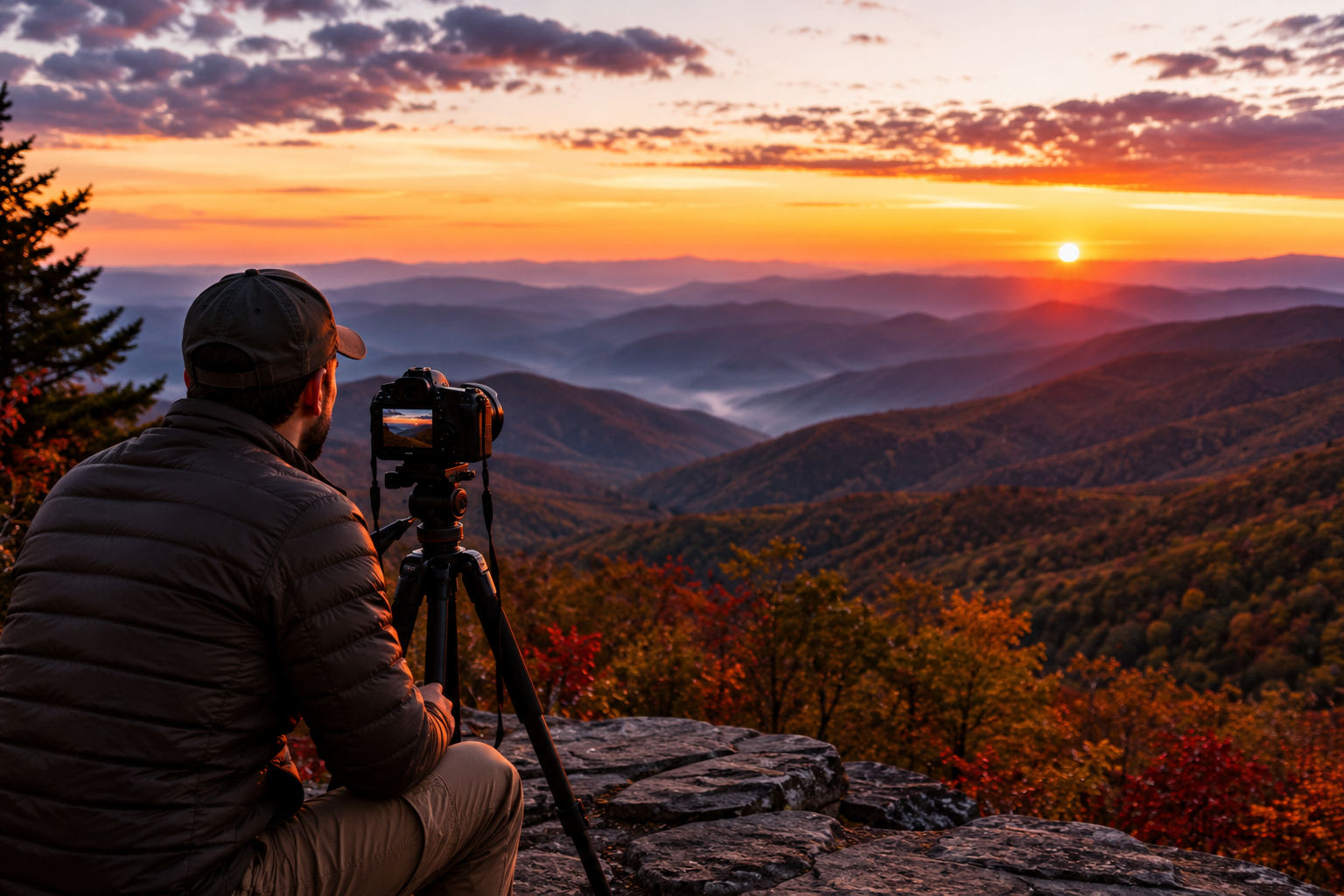
Few landscapes change as dramatically with the light as the Great Smoky Mountains. Before sunrise, valleys can fill with mist while distant ridgelines appear as dark silhouettes. By evening, those same mountains may turn blue and purple beneath a sky filled with warm sunset colors.
For photographers, campers, and travelers who simply want better vacation photos, timing can matter just as much as location. Arriving at an overlook in the middle of the afternoon can produce a completely different image from visiting the same place during the first or last hour of daylight.
If you’re camping near Gatlinburg, an early start or well-planned evening drive can put some of the Smokies’ most memorable scenery within reach. Use this Smoky Mountain photography guide to plan where and when to photograph sunrise, sunset, wildlife, waterfalls, and the mountain landscapes that make this region so distinctive.
Clingmans Dome for High-Elevation Sunrise Photography
Clingmans Dome, officially renamed Kuwohi in 2024, is the highest point in Great Smoky Mountains National Park and one of the most dramatic places to experience changing light across the mountains.
At more than 6,600 feet in elevation, the area offers expansive views across overlapping ridges. On clear mornings, the elevated perspective can produce the classic layered-mountain photographs associated with the Smokies.
Sunrise photographers should plan carefully because conditions at this elevation can be considerably colder and windier than around Gatlinburg. Fog and clouds can also arrive quickly.
Check current road access and weather conditions before leaving, particularly outside the warmer months when seasonal closures can affect access.
Even if conditions aren’t perfectly clear, don’t immediately assume the trip was wasted. Clouds moving through the mountains can create atmospheric photographs that are often more interesting than a completely cloudless sky.
Newfound Gap for Accessible Mountain Views
Newfound Gap is another excellent location for photographers who want broad mountain views without committing to a long hike before sunrise or after sunset.
The overlook sits along Newfound Gap Road and provides expansive views across the surrounding mountains. Its accessibility makes it particularly useful when you’re carrying a tripod, multiple lenses, or other photography equipment.
Morning conditions can produce mist and low clouds between the ridges, while evening light may add warmer tones to the landscape.
Arrive well before the light you want to photograph. If sunrise is at 6:45 a.m., for example, getting into position at 6:45 means you’ve already missed part of the show. The period before the sun actually appears can produce some of the most interesting colors.
The same principle applies at sunset. Stay for a while after the sun disappears because the sky can continue changing as daylight fades.
Morton Overlook for Classic Smoky Mountain Sunsets
If sunset is your priority, Morton Overlook deserves a place on your photography itinerary.
Located along Newfound Gap Road, the overlook provides a west-facing mountain view that has become especially popular around sunset. Layers of ridges extending toward the horizon can create a strong composition when evening light begins filling the sky.
Because it is well known, photographers shouldn’t expect to have the location completely to themselves during popular travel periods.
Arrive early enough to find a safe position and set up your equipment without rushing. This is particularly important during fall, when foliage season can bring considerably more visitors to the Smokies.
Bring a tripod if you plan to continue shooting as available light decreases. Slower shutter speeds become much easier to manage when your camera is stable.
Cades Cove for Sunrise, Wildlife, and Morning Mist
Not every great Smoky Mountain photograph needs to be taken from a high overlook.
Cades Cove provides a completely different type of landscape. Open fields, historic structures, surrounding mountains, and wildlife make it one of the most varied photography destinations in the area.
Early morning can be particularly rewarding. Mist sometimes settles over open fields while the surrounding mountains catch the first light of the day. Deer, wild turkeys, and other animals may also be active.
Black bears live in the area as well, but wildlife photography should always be done responsibly and from a safe distance. Never approach an animal to improve your photograph or position yourself between wildlife and its escape route.
If you’re interested in photographing animals during your trip, Arrow Creek’s Cades Cove wildlife viewing guide includes additional advice about timing, equipment, and responsible wildlife viewing.
A telephoto lens can help you capture detailed images without getting unnecessarily close.
Foothills Parkway for Layered Mountain Landscapes
The Smokies are famous for mountains that seem to continue endlessly toward the horizon, and Foothills Parkway provides opportunities to capture that layered appearance.
Multiple overlooks along the route offer different compositions, allowing photographers to experiment rather than relying on one predetermined viewpoint.
This is especially useful when conditions aren’t cooperating. One overlook may be covered in cloud while another section of the route offers clearer skies.
Sunset can be particularly dramatic when haze and atmospheric conditions separate the distant ridges into progressively lighter layers.
Try shooting with both wider and longer focal lengths. A wide-angle lens emphasizes the scale of the landscape, while a telephoto lens can compress distant ridges and make the layered effect more pronounced.
Roaring Fork for Forest, Stream, and Waterfall Photography
Sunrise and sunset aren’t the only times worth taking your camera into the Smokies.
Roaring Fork Motor Nature Trail provides opportunities to photograph forests, rushing water, historic buildings, and smaller landscape details. Overcast conditions can actually work in your favor here.
Bright midday sunlight often creates harsh highlights and deep shadows in forests. Cloud cover produces softer, more even light that can make streams, waterfalls, moss, and vegetation easier to photograph.
A tripod is particularly useful if you want to experiment with slower shutter speeds around moving water.
Instead of concentrating only on large landscapes, look for smaller compositions as well. Wet leaves, moss-covered rocks, reflections, old wooden structures, and flowing streams can tell just as much of the Smoky Mountain story as a panoramic overlook.
Photograph Mountain Mist After Rain
Rain can initially seem like bad news when you’ve planned a photography trip, but it can create some of the best conditions in the mountains.
The “smoke” associated with the Smokies is often most visually dramatic when moisture and clouds settle between ridgelines. After a rain shower, fog may drift through valleys and forests, creating constantly changing compositions.
Instead of putting your camera away, look for safe overlooks where you can photograph the weather moving across the landscape.
A telephoto lens can be particularly effective because it allows you to isolate individual ridges, patches of fog, or areas where sunlight breaks through the clouds.
If poor weather changes your outdoor plans entirely, Gatlinburg still offers plenty of alternatives. Campers can switch their itinerary and explore indoor attractions before returning to photography when conditions improve.
Capture Fall Color Throughout the Smokies
Autumn adds another dimension to Smoky Mountain photography.
Forests that are predominantly green during summer begin transitioning into combinations of yellow, orange, red, and brown. Because elevation varies throughout the park, foliage doesn’t usually change everywhere at exactly the same time.
Higher elevations may begin transitioning first, while lower valleys can remain green for longer.
That makes exploring several elevations worthwhile if photography is one of the main reasons for your trip.
Early morning and late afternoon light can enhance fall colors, but cloudy days shouldn’t be ignored. Soft, overcast light reduces harsh shadows and can produce rich color in forest scenes.
If you’re planning a longer autumn trip, staying near Gatlinburg gives you flexibility to revisit areas as weather and foliage conditions change. Arrow Creek offers RV, tent, and cabin camping near Gatlinburg, providing a convenient base for exploring different areas of the Smokies over several days.
Use Your Phone for Better Smoky Mountain Photos
You don’t need professional camera equipment to return home with excellent photographs.
Modern smartphones are capable of producing impressive landscape images, particularly when the lighting is good.
Start by cleaning the camera lens. It sounds minor, but fingerprints can create noticeable softness and flare when photographing toward sunrise or sunset.
Tap on the brightest portion of the scene and adjust exposure if your phone allows it. Slightly reducing exposure can help preserve color and detail in a bright sky.
Use grid lines to keep horizons level and experiment with placing the horizon away from the exact center of the image.
Most importantly, avoid excessive digital zoom. If possible, move closer or use one of your phone’s dedicated optical focal lengths instead.
Bring the Right Photography Gear
You don’t need to carry an entire studio into the mountains, but a few pieces of equipment can make photography considerably easier.
A basic Smoky Mountain photography kit might include:
- Camera or smartphone
- Wide-angle lens for landscapes
- Telephoto lens for wildlife and distant ridges
- Lightweight tripod
- Extra batteries
- Memory cards
- Lens cloth
- Rain cover or waterproof camera bag
- Small flashlight or headlamp
- Portable power bank
- Water and snacks
A headlamp is especially useful because sunrise photography often means leaving before daylight, while sunset photography can require returning after dark.
Dress for the conditions as well. Temperatures at higher elevations can be significantly different from those around your campground.
Stay Safe While Chasing the Perfect Photograph
A beautiful photograph isn’t worth putting yourself or anyone else at risk.
Use designated parking areas rather than stopping unexpectedly along mountain roads. Stay behind barriers at overlooks and avoid climbing onto unstable rocks or ledges simply to create a different angle.
If you’re photographing wildlife, maintain the distances required by park regulations and use a telephoto lens rather than approaching the animal.
Weather deserves equal respect. Fog can dramatically reduce visibility, storms can develop quickly, and temperatures can fall after sunset.
Let someone in your group know where you’re going, particularly when leaving before sunrise or photographing from more isolated locations.
Turn Arrow Creek Into Your Photography Home Base
Photographing the Smokies is easier when you don’t have to squeeze every location into a single day.
Staying several nights allows you to plan around changing weather, revisit a location when conditions improve, and dedicate different mornings and evenings to different parts of the mountains.
Arrow Creek Campground sits along the border of Great Smoky Mountains National Park and offers RV sites, tent camping, and cabins for travelers exploring the Gatlinburg area.
Before heading out for an early photography session, review the campground’s directions and location information so you can plan your route and travel time.
If you prefer having a comfortable indoor space for organizing equipment, charging batteries, and resting between early mornings and late evenings, Arrow Creek’s camping cabins provide another option.
Photograph the Smokies at Their Best
The best Smoky Mountain photographs rarely come from rushing to an overlook, taking one picture, and immediately leaving.
Give yourself time to watch the landscape change.
Arrive before sunrise. Stay after sunset. Watch fog move through a valley. Wait for clouds to separate. Explore forests when overcast skies soften the light, and keep your camera nearby after rain.
Locations such as Kuwohi, Newfound Gap, Morton Overlook, Cades Cove, Foothills Parkway, and Roaring Fork each show a different side of the Smokies. By combining several of them during your trip, you can return home with photographs that capture much more than one famous mountain view.
When you’re ready to plan your stay, browse the Arrow Creek Campground gallery and review available campground rates and site options for your next photography trip near Gatlinburg.